Disinformation Resilience for Public Administration
Advanced · 5 lessons · 71 min · 3 quizzes · 2 games · free · the whole course without sign-up
A course for staff of ministries, regional and local authorities, press officers and mayors. You will learn what information manipulation looks like and how to describe it without emotion, what to monitor, when to respond and when to stay quiet, how to get ahead of disinformation (prebunking) and how to correct it (debunking). You will cover the principles of crisis communication and build the foundations of institutional readiness: roles, procedures, cooperation and working with evidence. The course is politically neutral and uses fictional but realistic situations.
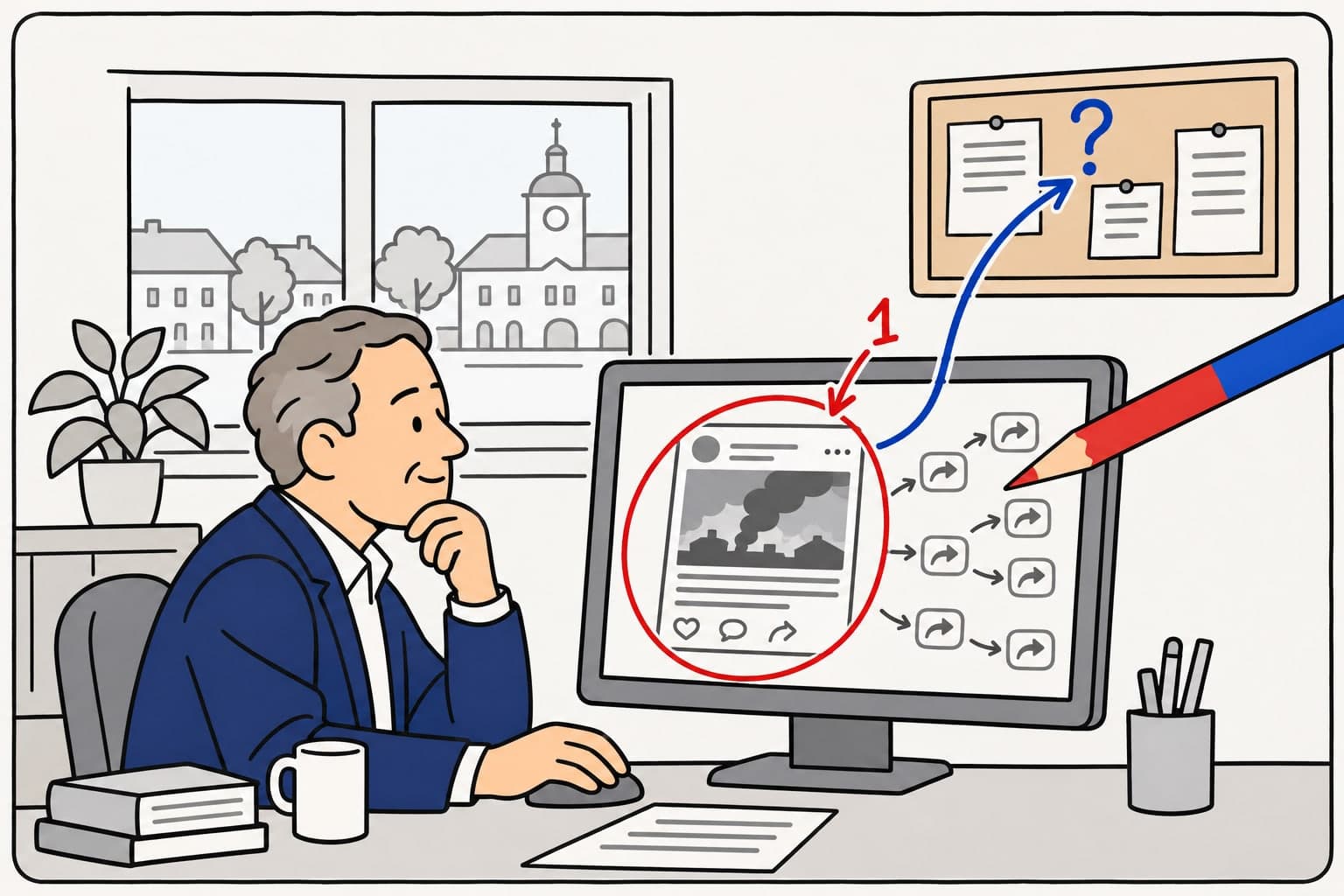
Account named “Eastbrook Town Council – Official” on social media
Due to reservoir repairs, the water supply will be cut off on Saturday. Water tankers are for registered residents only: enter your ID card number in the form (note 1).
- note 1, “enter your ID card number in the form”: No council asks for ID numbers like this
Sample no. 67
Take the whole course without registering. Create an account only when you want to save your progress.
Training your whole team?
We'll put together an offer for your organisation – fill in a short enquiry →
Course contents
- 1What information manipulation looks likeDisinformation, misinformation, malinformation, narratives and techniques – and how to describe manipulation objectively using the ABCDE and DISARM frameworks.15 min
- 2Monitoring and early detectionWhat to monitor, how to recognise escalation, and when it is better not to respond so that you do not amplify a falsehood.14 min
- 3Prebunking vs debunkingHow to prepare people for manipulation before it arrives, and how to correct a falsehood without amplifying it.13 min
- 4Crisis communication for public bodiesSpeed, clarity, a single voice and working with communities. Why an information vacuum always gets filled.14 min
- 5Institutional readinessRoles, procedures, cooperation with other institutions and decisions based on data and evidence.15 min
About this course
- Author
- Pavel Cinkeis, MBA, MPA (sources and procedures checked by the Kriticky.cz editorial team)
- Updated
- Sources
- Wardle & Derakhshan (2017): Information Disorder: Toward an interdisciplinary framework for research and policy making (Council of Europe) (opens in a new window)
- Pamment (2020): The EU's Role in Fighting Disinformation: Crafting A Disinformation Framework (Carnegie Endowment for International Peace) (opens in a new window)
- EEAS (2023): 1st EEAS Report on Foreign Information Manipulation and Interference Threats (opens in a new window)
Show all 6 sources
- Lewandowsky, Cook, Ecker et al. (2020): The Debunking Handbook 2020 (opens in a new window)
- Roozenbeek et al. (2022): Psychological inoculation improves resilience against misinformation on social media (Science Advances) (opens in a new window)
- WHO (2017): Communicating risk in public health emergencies: a WHO guideline for emergency risk communication (ERC) policy and practice (opens in a new window)
What next
Start with lesson 1: What information manipulation looks like
15 min · free · no sign-up