
Skip to content
Search

Text and colours

Text size
Colours

This browser remembers your settings.

Kriticky naživo (live)

Talks and workshops on scams and artificial intelligence

Using real messages with personal details blacked out, you practise spotting a scam and what to do when you are not sure. You take home a printed cheat sheet and can carry on online.

  • Nothing is sold at our events
  • Liberec Region first, elsewhere by agreement
  • From December 2026

For now, our talks and workshops are held in Czech, in Czechia, starting in the Liberec Region. An online session in English for a company or school is possible on request.

Ask about a talk or workshop

Who is organising?

Pick what fits you. The form will be filled in accordingly.

What one exercise looks like

You read a message and mark what doesn’t add up. Then we correct it together and talk about how to check it. At our events we use real messages: from readers who agreed to it, and based on police and bank warnings, with names, numbers and links blacked out. The example here is made up.

Made-up example based on real scams

Voice message from an unknown number; the voice sounds like your daughter

Mum, it’s me, I’m on a friend’s phone⁠ (note 1). I’ve had an accident and I need to pay €700 right now⁠ (note 2). Don’t tell Dad⁠ (note 3), I’ll send you the account number.

  1. note 1, “I’m on a friend’s phone”: A friend’s phone? Call her own number
  2. note 2, “I need to pay €700 right now”: Rush and fear: “right now”, “accident”
  3. note 3, “Don’t tell Dad”: Secrecy stops you asking anyone

Sample no. 82

What to do: don’t reply or send anything, call your daughter on the number you know and ask for the family password. A voice on its own is no longer proof.

Why we do this

Almost three quarters of respondents in Czechia (72%) worry about deepfakes: fake videos, voices and other fake content. Only about a quarter (26%) are confident they would recognise a convincing fake. Among people who don’t use AI, it is only about one in eight (13%).

Source: Czech Association for Artificial Intelligence, Czech Barometer of AI Concerns 2026 (email survey, 1 July – 31 August 2026, 1,407 adults). Recognising a deepfake is the respondents’ own estimate, not a test. The barometer at asociace.ai (in Czech) ↗

All the concerns in the barometer and what to do about them →

Who will come

Pavel Cinkeis, MBA, MPA will come, a corporate trainer and certified facilitator. He leads every talk in person, sometimes with an assistant.

He runs talks and workshops on the same examples as the website: you read a message, mark what doesn't add up, and then we talk about how to check it.

Who is behind Kriticky.cz →

Formats

From December 2026 we start with two formats and only a few events a month, so that each one is well prepared. A summary at a glance. Open any format to see the detailed programme. The price and date come in our offer.

From December 2026 · Can be free

Talk for older people: the fake grandson’s voice and the “banker” on the phone

Who it’s for:
Senior clubs, libraries, care homes, social services and towns for their older residents.
Length:
60 minutes, a break and an optional 20–30 minutes for questions
Group:
15–60 people. Microphone, large print on screen and on paper, spare reading glasses.

Ask about this →: Talk for older people: the fake grandson’s voice and the “banker” on the phone

Programme and what you take home

New tricks and how to handle them. Safely and calmly.

What you practise

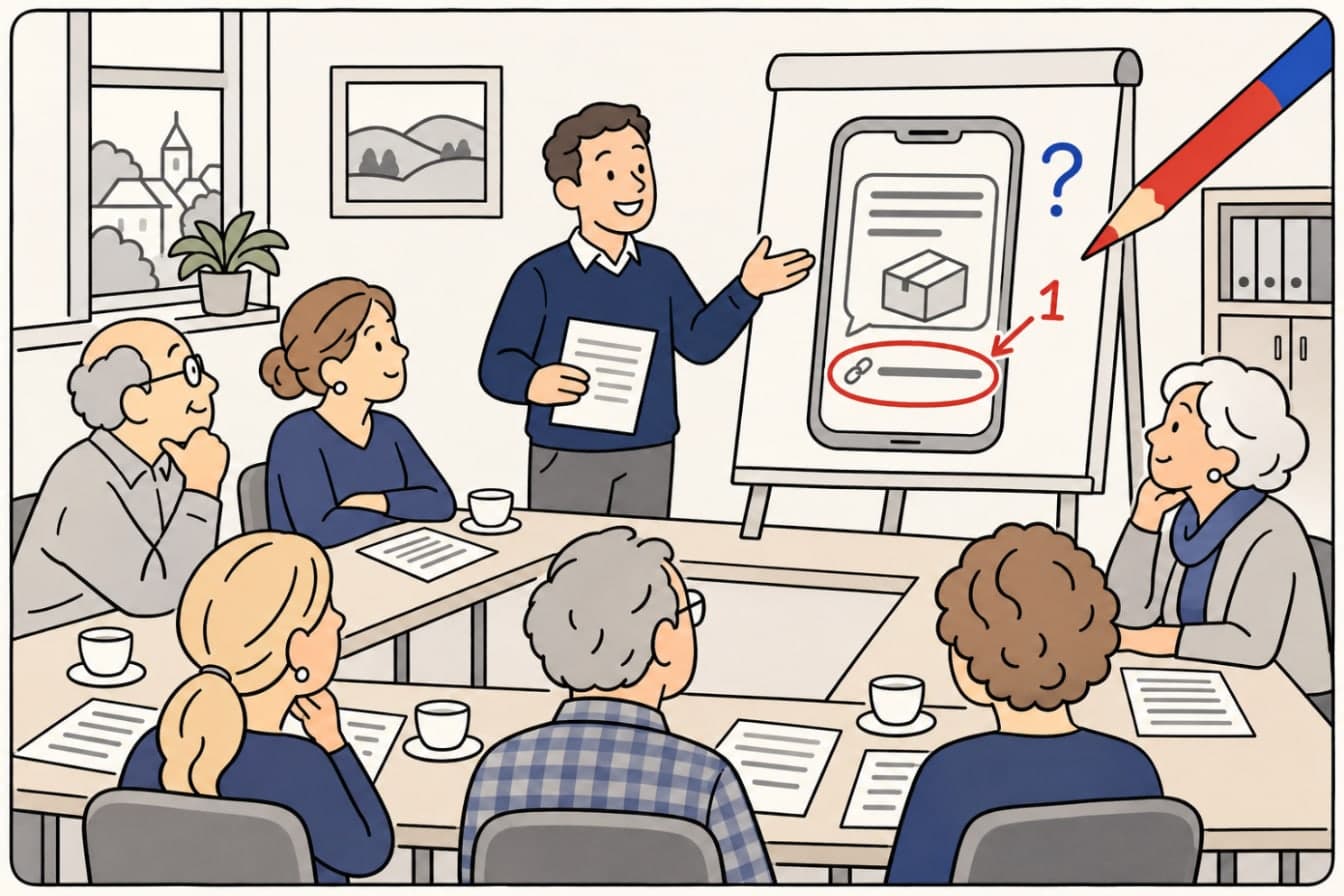
  • In pairs, you mark what doesn’t add up in three real messages. Names and numbers are blacked out.
  • We name five tricks that keep coming back: hurry, authority, fear, a prize and secrecy.
  • The speaker and a helper act out a call from a “banker” and the audience suggests what to say. Nobody from the audience is put on the spot.
  • You hear a pre-recorded example of a voice imitated by artificial intelligence. It is the speaker’s own voice, recorded with his consent.
  • We cover what to do if it has already happened: no shame, call your bank and the police straight away.

After the break, anyone who wants to can show us a suspicious message on their phone. The owner keeps hold of the phone; we copy the link into Link X-ray on our own device and open nothing. The organiser gets a poster and a short text for the local newsletter and public address system.

What you take home

  • A fridge cheat sheet with six rules and a wallet card
  • A “family password” card and a red pencil
  • A code for the online course, for you or someone close to you

How it continues online

The course for older people at home at their own pace, Link X-ray for suspicious addresses and “Send a message” when something odd arrives.

From December 2026

Human firewall, live

Who it’s for:
Companies and organisations, whole teams including production, reception and accounts.
Length:
60–90 minutes, or short 30–45 minute sessions between shifts
Group:
As many as the room holds, even the whole company. Hybrid with a recording is possible.

Ask about this →: Human firewall, live

Programme and what you take home

For all staff: payment fraud, the fake director and the imitated voice.

What you practise

  • Four real cases: a supplier’s changed bank account, a fake director with an imitated voice, fake IT support asking you to approve a login, and an invoice for a bogus “register entry”.
  • A recorded example of a cloned voice and what it means for approving payments.
  • Three rules for the company: check another way, four eyes on every payment, reporting a mistake is never punished.
  • Ten minutes at the end on protecting your own parents.

For Czech companies under NIS2: the session covers the topics “social engineering techniques” and “current cyber security threats” from Annex 3 of Decree No. 410/2025 Coll. It is up to you what you count towards mandatory training.

What you take home

  • A printed checklist against scams and disinformation
  • An attendance sheet for your training records
  • Codes for the online workplace course, if you want them

How it continues online

The online course on manipulation at work, the Critical Thinking at Work certification and a printable checklist.

On request

Staff room: critical thinking, scams and AI at school

Who it’s for:
The teaching staff, small staff rooms included.
Length:
8 × 45 minutes (one day, or 4 hours in person and 4 hours live online), or a shorter session
Group:
The whole staff

Ask about this →: Staff room: critical thinking, scams and AI at school

Programme and what you take home

For primary and secondary school teachers.

What you practise

  • The same exercises the pupils get, and how to run them in class.
  • Scams aimed at children and at parents: games, shopping, social media, extortion and deepfakes.
  • Artificial intelligence at school: how to check what it produces and where it gets things wrong.
  • What to do when a child confides in you: listen, promise nothing and pass it to the school’s prevention lead the same day.

What you take home

  • A printed checklist for the staff room
  • Codes for the online media literacy course for teachers
  • A certificate of attendance stating the hours

How it continues online

Free missions for pupils with a classroom mode, class kits with ready-made lessons and the Media Literacy Teacher certification.

On request

School classes: Spot the Scammer and Little Detectives, live

Who it’s for:
Primary classes (ages 6–15) and secondary schools.
Length:
2 × 45 minutes
Group:
One class. We can teach several classes on the same day.

Ask about this →: School classes: Spot the Scammer and Little Detectives, live

Programme and what you take home

Two lessons for younger and older pupils, linked to the missions for children on the website.

What you practise

  • Older pupils build a scam message with made-up brands in groups, and another group has to unmask it.
  • Younger pupils look for clues like detectives in stories about made-up characters, not in their own experiences.
  • Everything on paper and from the teacher’s computer. Pupils don’t need phones.

Rules for working with children: the speaker is never alone with a child, takes no photos of children and never works with their voices or faces. If a child confides in us, we pass it to the school the same day.

What you take home

  • A diploma for every pupil
  • Homework: free missions on the website, no account needed
  • A short note for parents on why practising in advance works

How it continues online

The teacher continues with the missions in classroom mode and the class kits with ready-made lessons.

On request

A short slot for towns: the town as a shield

Who it’s for:
Mayors, councils, meetings of mayors, micro-regions and local action groups.
Length:
15–20 minutes
Group:
A council or meeting

Ask about this →: A short slot for towns: the town as a shield

Programme and what you take home

15–20 minutes at a council meeting or a mayors’ meeting. Free.

What you practise

  • Which scams are currently targeting older people in the region and how to spot them.
  • What a town can do right away: an article in the newsletter, an announcement, a talk in the library.

We talk about scammers’ tricks, not politics.

What you take home

  • A free communication pack: a newsletter article, a text for announcements and a social media post

How it continues online

The online course on resilience to disinformation for public administration.

With partners and foundations

We run talks for seniors’ clubs, libraries and social services free of charge while we have capacity. Larger events, such as a series of talks for a whole town, region or library network, we want to run with partners and foundations so they stay free for the people who come.

  • Libraries and non-profits get material for their grant application from us: a programme description, a budget and what remains after the event.
  • We will name our partners here once a partnership starts.

I’d like to be a partner →

For curious organisersHow we measure whether an event helped, where artificial intelligence comes in and what you can rely on.

How it works

  1. Send an enquiryA few details are enough: who you are, who the event is for and when would suit you.
  2. We reply within two working daysWe ask about the audience and the venue. The price and date come in our offer.
  3. We prepare the event for your audienceWe choose exercises to suit the audience and the region. Organisers of talks get a poster and a newsletter text.
  4. After the eventWe send a short summary from the anonymous quiz. Participants carry on online.
How we tell whether it helped

We want to know whether the event really changed something, and tell you too.

  • An anonymous paper quiz with three harder situations before and after the event: a “police officer” wants a transfer to a safe account, a grandson’s voice calls from an unknown number, and an investment ad shows a famous face. Slips go face down into a box.
  • At the end, the question “What will you do this week?” and a rating of the event from 1 to 5.
  • We will also try to measure behaviour: how many people agree a family password within 14 days. We will ask the organiser to check anonymously at their next meeting.
  • The organiser gets a short summary: number of participants, the change in the quiz and the rating.
  • We also track how many people use their course code afterwards and how many new suspicious messages reach us from the region.

The quiz only shows the immediate change in knowledge, not whether people will resist a scam a month later. That is exactly how we report it. The effect of practising in advance fades over time, which is why every event continues online.

We will publish the results of the first months (December 2026 to March 2027), including a summary of the quizzes, on this website by the end of June 2027, even if they don’t go to plan.

Where artificial intelligence comes in
  • We show what scammers can do today

    A pre-recorded example of a voice imitated by artificial intelligence. It is the speaker’s own voice, recorded with his consent. We never imitate participants’ voices or faces and never use voice-cloning tools with children.

  • We teach a routine, not false certainty

    Nobody can reliably tell a good fake by its voice or picture today. So we teach checking another way: hang up, call back on a number you know, ask for the family password and talk to someone.

  • Sensible AI at work and at school

    With companies and teachers we also cover how to check what AI tools produce and where they tend to get things wrong.

  • The AI check, live

    The speaker retypes a suspicious message from the audience, without personal details, into the AI message check. The room looks for the tricks first, then we compare with the AI, including where it got things wrong.

    Try the AI message check →

How we use artificial intelligence ourselves

What you can rely on

  • No scaremongering, no shaming

    Nobody is put on the spot or tested in front of others. Anyone can be fooled, even people who know a lot about scams.

  • Nothing is sold

    Nothing is sold at public events. The course code is a gift for you or someone close to you.

  • Neutrality

    We take apart tricks, not parties. We don’t use current political examples.

  • Safe with phones and messages

    We never open links from the audience, the owner always keeps hold of the phone and we don’t photograph participants’ phones. We only copy a message with consent and without personal details.

  • Not accredited, and we say so

    Our programmes are not accredited. Czech schools may pay for non-accredited training from the templates, but we cannot issue certificates under the Czech act on local government officials.

Enquiry

Fill in what you know. We reply within two working days. The price and date come in our offer.

What are you asking about? (required)
About you
Contact

We’ll send the offer here.

More details (optional)Phone, number of people, dates, venue, payment and a note.
The event

Give two or three dates, or at least a month.

Town and venue, such as a library or meeting room. Or online.

How would the event be paid for? (optional)

For example who the event is for, what worries you or what equipment the room has.

We only use the details in this enquiry to prepare an offer and to contact you. How we handle your data