Critical Thinking in the Age of Disinformation
Getting started · 7 lessons · 56 min · 5 quizzes · 7 games · free · the whole course without sign-up
The point is not to believe nothing. The point is to know what to believe and why. In each lesson you first try it out on an example and then get one rule you can use straight away.
- 7 lessons of 8 minutes each, all free. The first lesson needs no registration.
- Games, stories and a practice conversation. Nothing is sent anywhere.
- At the end, a printable cheat sheet with seven questions.
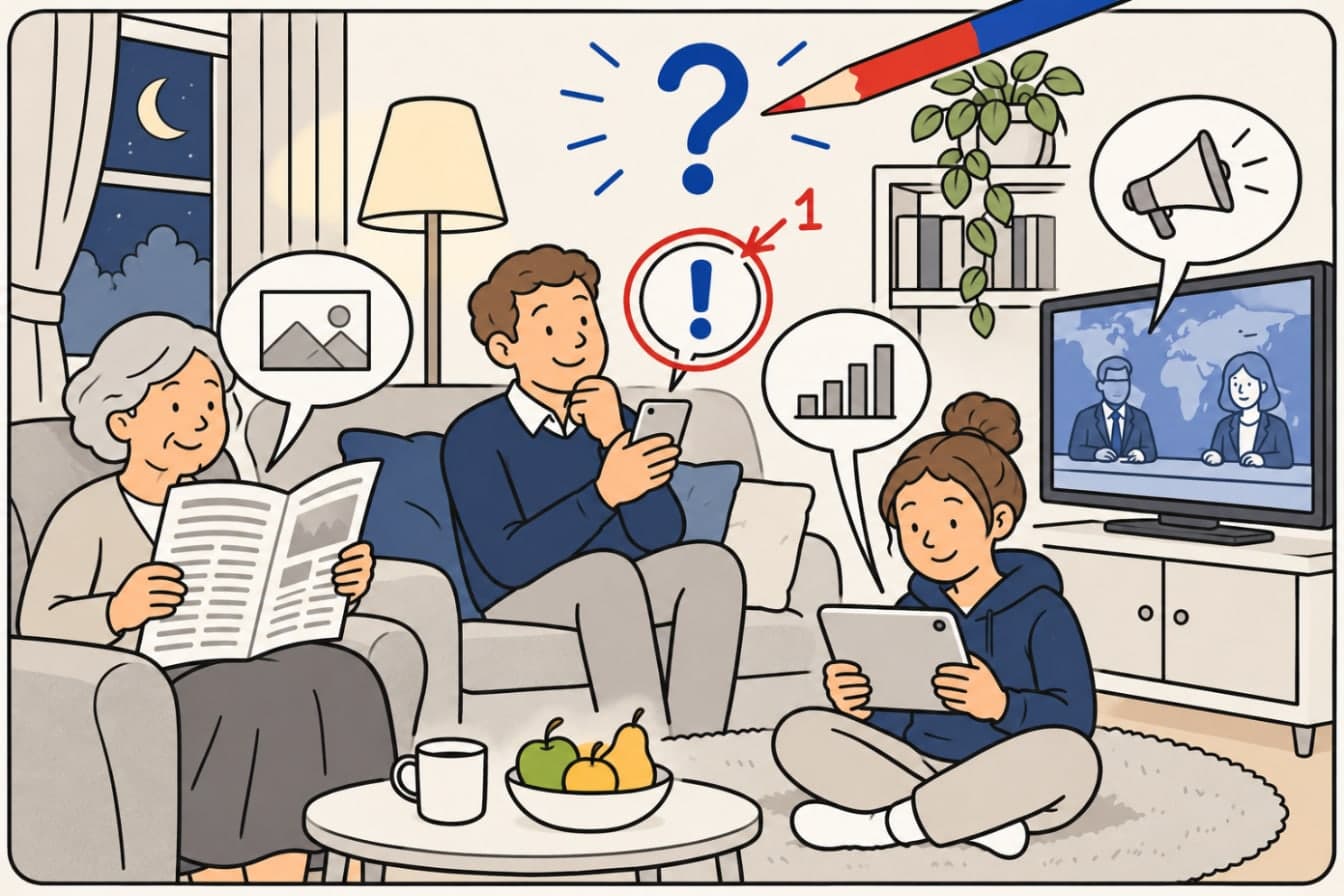
Message in a family group chat
They say the tap water isn’t safe. Pass it on before they delete it! (note 1)
- note 1, “Pass it on before they delete it!”: A call to share instead of evidence
Sample no. 238
Start lesson 1 (8 min) →
Take the whole course without registering. Create an account only when you want to save your progress.
Course contents
- 1Why we believe it: emotion, repetition and hurryDisinformation doesn’t target stupid people. It targets the moments when we are rushed, frightened or angry.8 min
- 2What is what: news, opinion, advertising, satire and honest mistakesNot everything untrue is a lie, and not everything true is the whole truth. First find out what you are actually reading.8 min
- 3Who says so: check the source sidewaysDon’t judge an unfamiliar website by its looks. Open a new tab and find out what others say about it.8 min
- 4Photos, videos and artificial intelligenceYou can’t spot a fake by eye, and a real photo can be used to lie. What matters is where the picture comes from.8 min
- 5Numbers and “a study proves”A number looks like a fact. Four questions show whether there is anything behind it.8 min
- 6Tricks in arguments: us versus themThe texts that spread most are the ones that split people into two camps. Learn to find what the dispute is really about.8 min
- 7How to talk about it and what to pass onWith someone close who has believed something, an argument is not there to be won. And each of us decides what we pass on.8 min
About this course
- Author
- Pavel Cinkeis, MBA, MPA (sources and procedures checked by the Kriticky.cz editorial team)
- Updated
- Sources
- Pennycook & Rand (2019): Lazy, not biased: Susceptibility to partisan fake news is better explained by lack of reasoning than by motivated reasoning (opens in a new window)
- Martel, Pennycook & Rand (2020): Reliance on emotion promotes belief in fake news (opens in a new window)
- Fazio, Brashier, Payne & Marsh (2015): Knowledge does not protect against illusory truth (opens in a new window)
Show all 21 sources
- Vosoughi, Roy & Aral (2018): The spread of true and false news online (opens in a new window)
- Sundar et al. (2025): Sharing without clicking on news in social media (opens in a new window)
- Pennycook et al. (2021): Shifting attention to accuracy can reduce misinformation online (opens in a new window)
- Wardle (2020): Understanding Information Disorder (First Draft) (opens in a new window)
- European Commission: Tackling online disinformation (opens in a new window)
- Wineburg & McGrew (2019): Lateral Reading and the Nature of Expertise (opens in a new window)
- Breakstone et al. (2021): Students’ Civic Online Reasoning: A National Portrait (opens in a new window)
- Moore & Hancock (2022): A digital media literacy intervention for older adults improves resilience to fake news (opens in a new window)
- Aslett et al. (2024): Online searches to evaluate misinformation can increase its perceived veracity (opens in a new window)
- Kozyreva, Wineburg, Lewandowsky & Hertwig (2023): Critical Ignoring as a Core Competence for Digital Citizens (opens in a new window)
- Diel et al. (2024): Human performance in detecting deepfakes: A systematic review and meta-analysis of 56 papers (opens in a new window)
- Chesney & Citron (2019): Deep Fakes: A Looming Challenge for Privacy, Democracy, and National Security (opens in a new window)
- Eurostat (2025): Evaluating data, information and digital content (isoc_sk_edic_i21) (opens in a new window)
- CEDMO Trends ČR, 29. vlna (2025) (opens in a new window) (in Czech)
- Brady et al. (2017): Emotion shapes the diffusion of moralized content in social networks (opens in a new window)
- Lewandowsky, Cook et al. (2020): The Debunking Handbook 2020 (opens in a new window)
- Holford et al. (2024): The empathetic refutational interview to tackle vaccine misconceptions (opens in a new window)
- Maertens et al. (2025): Psychological booster shots targeting memory increase long-term resistance against misinformation (opens in a new window)
What next
Start with lesson 1: Why we believe it: emotion, repetition and hurry
8 min · free · no sign-up